ADEnergy · Men's Health
I fell asleep on my own sofa three Thursdays running. It was not my age.

If you are tired the moment you walk through your own front door, this will sound familiar.
Work is fine. The day gets done. Then somewhere between leaving the desk and sitting down at your own table, whatever was left runs out. You eat without talking much. You let someone else do the bath and bedtime. You say "we'll see" instead of "no", because saying no means an argument and you do not have one in you.
I spent about eighteen months assuming that was just what forty-four looks like.
It was not. The thing that finally made sense of it had nothing to do with my age, my job, or how much I was sleeping. It had a time stamp on it, and the time stamp was four o'clock in the afternoon.
Here is what I found, in the order I found it.
The Thursday I stopped pretending it was normal
The specific evening I remember was a Thursday.
Five-a-side, third week running, and I cancelled again by text from the car park at work. Not my knees. Not a late meeting. I just sat there and could not make myself drive to the pitch.
I got home at ten past six. My son asked if I would look at something on his tablet. I said "in a minute". I sat down on the sofa to take my shoes off and the next thing I knew the television was on and it was quarter past nine and nobody had woken me because it had stopped being unusual.
That was the part that got me. Not the falling asleep. The fact that it had become normal enough that nobody mentioned it.
So I did what you do. I tried to sleep more. Nine hours on a Saturday, and by six on Sunday evening I was in exactly the same state as after six hours on a Tuesday. I tried finishing earlier. Five o'clock, then four, then a half day. Same thing, just earlier. I got my bloods done and everything came back squarely normal, which is somehow worse, because now you have no explanation and no permission to complain.
What I never questioned, in eighteen months of trying to fix it, was the flat white I bought at ten past four every single afternoon.
The Afternoon Debt
Here is the part I had wrong, and I think most men have it wrong the same way.
Caffeine does not create energy. It never did. It is not fuel, and it never gets converted into anything your body can spend.
What it does is block a signal.
All day, your body produces a molecule called adenosine, and adenosine is the messenger that tells your brain how long you have been awake. The longer the day runs, the more of it builds up, and the heavier you feel. That is the system working correctly.
Caffeine fits into the same receptor that adenosine uses. It sits in the doorway. The message cannot be delivered, so you stop feeling tired.
But read that again, because it is the whole thing: the adenosine does not go anywhere. It keeps building the entire time. You have not removed the tiredness. You have muted the notification while the pile behind it gets taller.
And caffeine wears off. In most adults it has a half life of roughly five to six hours, which varies a fair amount from person to person depending on genetics, whether you smoke, and what medication you are on. Round numbers: the coffee you drink at four is still half present at ten at night.
So the fourth coffee at four o'clock does not hand you two extra hours.
It lends them. And the loan comes due somewhere around half six, all at once, exactly when you are putting your key in your own front door.
That is what I started calling The Afternoon Debt, and it is why the crash has a timetable. It is not that you are old. It is not that you slept badly. It is that you have been paying for your afternoons with your evenings, every day, for years, and nobody ever showed you the invoice.
There is a second bill, further out. Studies indicate that caffeine taken as much as six hours before bed still measurably disrupts sleep, which means the four o'clock cup is quietly taxing the night as well as the evening. That particular study was small, twelve people, so I would not lean on it too hard. But it points the same direction as everything else.
None of this is your fault. Nobody sold you the fourth coffee as a loan.
The other side of the ledger
Once you see the debt, the question changes.
Everything I had tried was on the wrong side of the ledger. Sleeping more, finishing earlier, more coffee, less coffee: all of it was managing what I had left. None of it put anything back.
So I went looking for the other side. Not something that blocks a signal. Something that has to do with actually making the energy.
Your cells run on a coenzyme called NAD. It sits inside the step where the food you eat becomes energy you can spend, and there is no way round it. No NAD, no conversion.
Your body does not swallow NAD. It builds it, from precursors.
There are three precursors in the supplement aisle. Two of them are the ones you have seen advertised, in the expensive jars, and I am not going to name them here because I do not need to. The third one has a boring name and a very unusual property: it is the only one the British regulator lets you make claims about.
Vitamin B3. Niacin.
The European food safety authority assessed it and concluded, in writing, that nicotinic acid and nicotinamide "function mainly as precursors of the co-enzymes NAD and NADP", with roles in mitochondrial respiration. On the back of that assessment, four statements about niacin are authorised for use on a label in Britain. Three of them matter here:
- Niacin contributes to the reduction of tiredness and fatigue
- Niacin contributes to normal energy-yielding metabolism
- Niacin contributes to normal psychological function
Those are not my words. They are the regulator's, and you can look them up in about ninety seconds.
I want to be careful here, because this is exactly where the category loses people. That is a modest claim. It is not "feel invincible" and it is not a transformation. It is a contribution to the reduction of tiredness and fatigue, and that is genuinely all anyone is allowed to say.
But that is the honest side of the ledger, and it is the only side that puts something back. Stop borrowing from the evening. Start the day with something in reserve instead.
That is the whole idea, and it is where the name came from.
The Evening Reserve
The version I ended up taking is called The Evening Reserve.
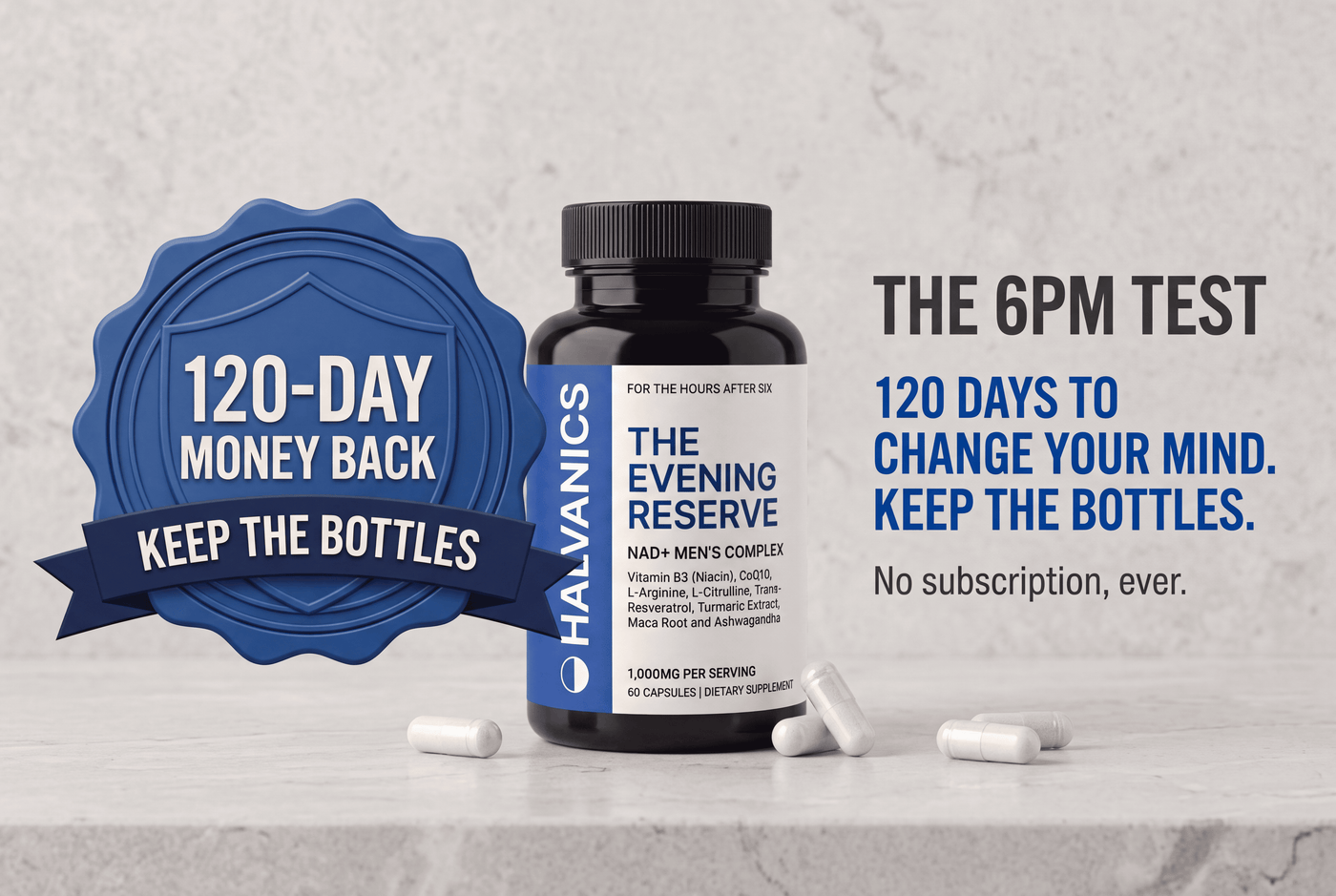
Two capsules, in the morning, with whatever you are already having. One thousand milligrams per serving. Sixty capsules in a bottle, so a bottle is a month. It is made in Britain and third party tested, which by now I check for as a matter of course.
Vitamin B3 is the active with permission, and it is the one the whole thing rests on. There are eleven supporting botanicals alongside it, including CoQ10, L-arginine, L-citrulline, trans-resveratrol, turmeric, maca and ashwagandha. I am not going to pretend those eleven are doing something the regulator has not agreed they do. They have not been assessed for that. If a page tells you otherwise, that page is telling you something it cannot back up.
One more thing, and it is the reason I bought it in the first place rather than one of the others. It is a one off purchase. You buy bottles. Nothing renews. I had been caught twice by the other kind, where you order once to try it and then a subscription you never agreed to keeps arriving, and the second time I ended up with an absurd quantity of something I had already decided did not work. If you have had that happen, you know it does not make you angry at the subscription. It makes you distrust the entire category.
What it costs, and why I would not buy one bottle
Here is the offer, plainly, because you have read far enough to deserve it plainly.
The reason most people take three is not the discount. It is that the second bottle costs you £24 and the third costs you £20, so the further you go the cheaper the next month gets. And it is the honest amount of time. Which brings me to the thing I want to say before you decide.
Do not buy one bottle.
I know how that reads coming from a page that is selling you something. But the single most common complaint in this entire category, by a distance, is a man saying the product did nothing for him after about seven weeks. Seven weeks. One bottle is four. If you buy one month and judge it at the end of one month, you will be judging it in exactly the window where the complaint comes from, and you will probably conclude it does not work, and you will be drawing that conclusion from an incomplete test.
Three months is the honest window. That is why the third bottle is the cheap one.
The 6pm Test
Take the full three months. If your evenings have not changed, email us any time in the first 120 days, keep the bottles, and I will refund you myself. No form, no return label, no questions.
I want to be specific about why the number is 120 and not 30. Thirty days is the industry standard and it is a trick, because thirty days is shorter than the time the thing needs. You get four months to decide, on three months of product, which means the window to ask for your money back stays open for a full month after the last capsule.
And the log is what makes that judgeable. You will not be trying to remember. You will be looking at fourteen numbers you wrote down yourself.
Two ways this goes
One
Nothing changes. You buy the flat white at ten past four tomorrow like you did today, and the bill arrives at half six like it always does, and in a year you will have had another two hundred and sixty evenings that ended on the sofa with the television on. Nobody will comment on it, because it stopped being unusual a long time ago.
Two
You move the coffee to before two, you take two capsules in the morning, and you write one number down each night for a fortnight. Then you look at the paper and decide, with evidence, whether it did anything.
The second one costs £79 and four months of your attention, and you can get the £79 back.
I know which one I picked.
120 days to change your mind, and the bottles stay with you. Nothing renews.
P.S. If you take one thing from this page and buy nothing, take this: move your last coffee to before two o'clock and see what happens by the end of next week. That part is free and it is the half of the mechanism you control on your own. The capsules handle the other half.
P.P.S. The single bottle exists because some people want it. I would still not start there. Three bottles is £26.33 each, the guarantee runs four months, and the test only means something if you run it long enough to be worth running.
P.P.P.S. Nothing here renews. You buy bottles, the bottles arrive, and that is the end of the transaction until you decide otherwise. If you have been stung by an automatic subscription you did not agree to, that is the specific reason this is set up the way it is.
Halvanics
This page is an advertisement. It is published by Halvanics, the seller of The Evening Reserve, and it is written in the first person by a named author who is connected to the brand. It is not independent journalism and it is not a customer review.
The Evening Reserve is a food supplement, not a medicine. Food supplements should not be used as a substitute for a varied and balanced diet and a healthy lifestyle. Do not exceed the recommended dose. Keep out of the reach of young children. If you are pregnant, breastfeeding, taking prescribed medication or under medical supervision, speak to your doctor before use.
The only health claims made on this page are the authorised niacin claims quoted above. No claim is made for the eleven supporting botanicals, which have not been assessed for the purpose described here. Individual experience varies.
© 2026 Halvanics. All rights reserved.